
Table of Contents
- Hiring Professional Movers vs DIY: Quick Comparison
- Pros and Cons of Hiring Professional Movers
- Pros and Cons of DIY Moving
- Average Cost of Professional Movers vs Hidden DIY Expenses
- Moving Truck Rental Prices and Liability Coverage Options
- DIY Moving Checklist: Essential Tasks and Time Requirements
- Hybrid Moving Solutions: A Middle Ground Worth Considering
- How to Choose: Local Relocation vs Long-Distance Moves
Hiring Professional Movers vs DIY: A 2026 Cost & Effort Guide
Last Updated: July 11, 2026
When relocating within Victoria or across Australia, the decision between hiring professional movers vs DIY depends far less on budget alone than most people think. The real trade-off involves time, stress, risk, and whether you’re equipped to handle the physical and logistical demands of a move.
This guide breaks down everything you need to know to make an informed decision, from hidden costs that inflate DIY budgets to the real value of full-service moving companies.
Hiring Professional Movers vs DIY: Quick Comparison
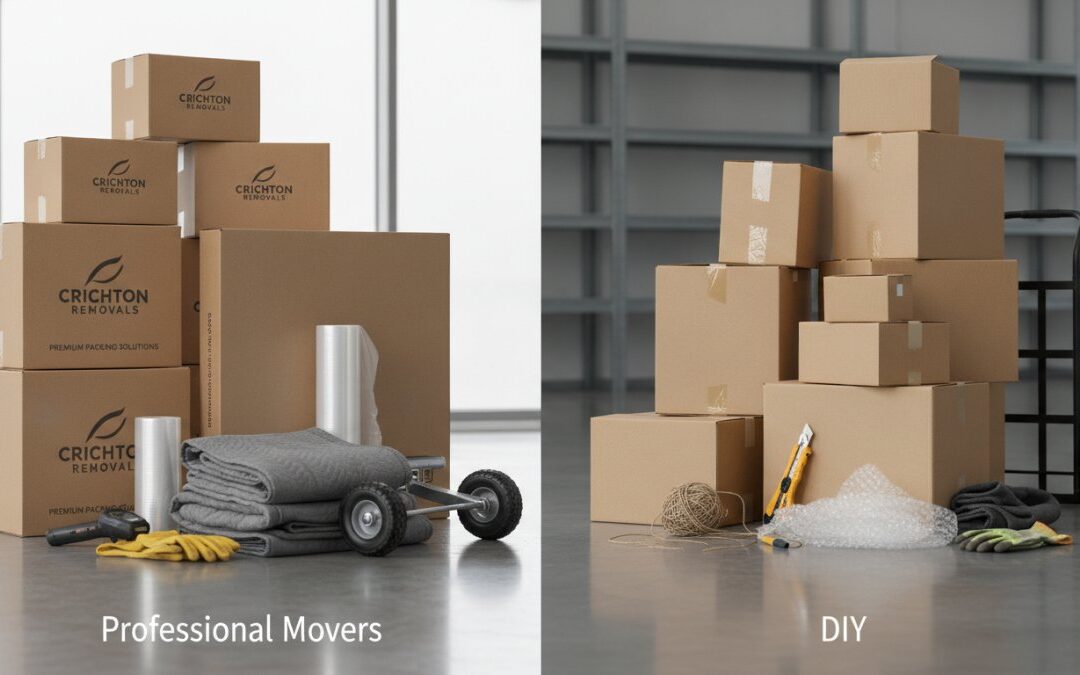
Professional moving companies handle everything: packing, loading, transportation, unloading, and often unpacking. DIY moving puts you in control of costs but demands significant time, physical labor, and liability exposure.
| Factor | Professional Movers | DIY Moving |
|---|---|---|
| Physical Labor | Handled by trained crews | You and friends/family |
| Packing & Materials | Included (full-service) | Your responsibility |
| Transportation | Professional truck + drivers | Rental truck you drive |
| Damage Risk | Covered by liability | Your responsibility |
| Time Investment | 1-2 days | 2-4 weeks of planning + moving day |
| Hidden Costs | Transparent quotes | Truck rental, fuel, supplies, equipment |
| Stress Level | Low (delegated) | High (you coordinate everything) |
| Best For | Long-distance, complex, high-value items | Local moves, minimal items, experienced movers |
The choice hinges on three variables: distance, complexity, and your capacity to absorb risk and effort.
Pros and Cons of Hiring Professional Movers
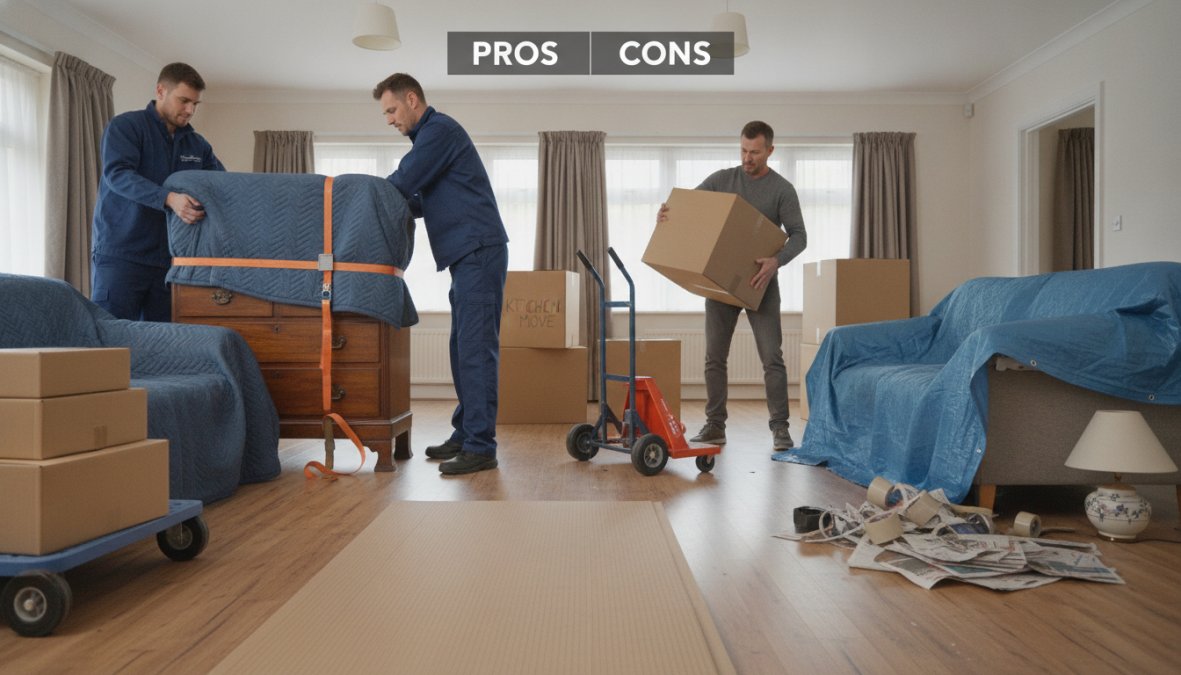
Choosing professional movers means paying for expertise, liability protection, and peace of mind.
Key Advantages of Full-Service Moving
Professional movers provide specialized handling for heavy or delicate items that DIY movers cannot replicate safely. They carry insurance protecting your belongings if something goes wrong, if furniture breaks during a professional move, the company’s valuation protection covers the loss. If it breaks during DIY moving, you’re out of pocket.
Professional teams complete in one day what might take you and friends two or three weekends. For interstate moves, this efficiency reduces logistics stress significantly. Long-distance moves particularly favor professional movers due to the complexity of coordinating transportation, storage transitions, and liability over hundreds of kilometers.
Professional movers excel when moving long-distance, handling high-value items, or when your time is genuinely more valuable than the moving cost. The liability protection alone justifies the expense for moves involving valuable or irreplaceable items.
Potential Drawbacks to Consider
The primary drawback is cost. Full-service moving companies charge significantly more than DIY alternatives, particularly for local relocations. Scheduling inflexibility also creates friction, professional companies book weeks in advance, and timeline shifts can force rescheduling or premium rates.
Some people resist losing control over their belongings. While professional movers are trained and insured, you’re trusting another company’s team with your possessions. Minimum service requirements can also inflate costs, forcing you to pay for services you don’t need.
Pros and Cons of DIY Moving
DIY moving appeals to budget-conscious movers with relatively simple relocations, but hidden costs and physical demands often surprise people.
Why DIY Appeals to Budget-Conscious Movers
The upfront cost appears dramatically lower than professional estimates. Truck rentals start at base rates far below professional quotes. Control is the second major appeal, you decide what gets packed, how items are protected, and when loading happens.
DIY moving also suits people with minimal possessions or those moving very short distances. If you’re relocating three blocks away with a small apartment, the cost-to-benefit ratio of hiring professional movers doesn’t make sense.
DIY moving works best for local moves under 50 kilometers, when you have fewer than 20 boxes, or when you’re moving with friends or family who are genuinely available and physically capable.
Real Challenges You’ll Face
The physical demands are often underestimated. Loading a truck means lifting heavy furniture and boxes repeatedly. Most people lack proper equipment, dollies, moving blankets, and lifting straps, creating real risks for back injuries and property damage.
Time investment extends far beyond moving day. Planning takes weeks: researching truck rental companies, gathering boxes, notifying utilities, and coordinating helpers. The actual move consumes a full day or weekend. Unpacking takes another week or more. Total time commitment easily reaches 40-60 hours.
Hidden costs accumulate quickly. A truck advertised at $19.95 per day becomes $150-250 once mileage, fuel, insurance, and equipment are added. Boxes, tape, bubble wrap, and packing materials cost $100-300. If you damage the rental truck, you pay the damage waiver or deductible. Equipment rental and helper costs add more expense.
Liability and damage risk rest entirely on you. If a friend injures themselves while helping, you could face liability questions. If your belongings get damaged, there’s no insurance claim to file.
Average Cost of Professional Movers vs Hidden DIY Expenses
Understanding the true cost of each option requires looking beyond advertised prices.
What Affects Professional Moving Pricing
Professional moving costs depend on distance, volume, and complexity. A local move within Geelong costs far less than an interstate relocation. Moving a three-bedroom house costs more than a one-bedroom apartment. Moves involving heavy items, delicate antiques, or specialized equipment command premium rates.
Timing affects availability and rates, peak season (summer, end of month) costs more than off-season moves. Professional movers provide transparent quotes based on inventory assessment. The best approach is requesting quotes from multiple companies to compare pricing structures.
Beware of quotes that seem unusually low. Professional movers with suspiciously cheap estimates may cut corners on insurance, use inexperienced crews, or add hidden charges later.
Hidden Costs That Inflate DIY Moving Budgets
Truck rental pricing looks affordable until you add mileage charges. A truck at $19.95 per day becomes $60-80 with mileage. Fuel for a truck getting 6-8 miles per gallon adds significantly to longer moves.
Packing materials cost $100-300 depending on move size. Equipment rental (dollies, furniture pads, lifting straps) costs $20-50. Helper expenses accumulate subtly, even unpaid helpers typically receive meals and small payments ($50-100 per person), reaching $300-600 for 4-6 helpers.
Insurance gaps create hidden risk. Damage waivers cost $15-30 per day, or you face a deductible ($500-2,500) if you cause damage. Your personal belongings have zero coverage if damaged during DIY moving. Storage costs arise if move-in dates don’t align, adding $50-100 for a two-week gap.
When you calculate truck rental ($150-250), fuel ($50-100), packing materials ($150-300), equipment rental ($30-50), helper costs ($300-600), and potential damage or storage ($100-500), a DIY move easily reaches $800-1,800 for a moderate relocation. For larger moves, DIY costs approach professional moving prices while eliminating liability protection.
Moving Truck Rental Prices and Liability Coverage Options
Understanding truck rental options and insurance protection is critical for DIY movers.
Understanding Rental Insurance and Valuation Protection
Truck rental companies offer damage waiver (collision damage waiver) and liability coverage. The damage waiver protects the truck itself if you cause damage, typically costing $15-30 per day. Liability coverage protects other people if you cause injury or damage to their property, though it’s often limited ($300,000-500,000).
Your personal auto insurance may extend to truck rentals, but verify this before renting. Valuation protection for your belongings doesn’t exist in DIY moving unless you purchase moving insurance separately from a third-party provider, costing $200-500 depending on declared value.
Professional movers typically include basic liability coverage in their quotes.
Purchase moving insurance for DIY moves if you’re transporting items worth more than $5,000. The $200-500 cost provides essential protection against loss or damage.
DIY Moving Checklist: Essential Tasks and Time Requirements
A successful DIY move requires systematic planning across multiple phases spanning 4-6 weeks.
Planning Timeline and Physical Demands
Begin planning 6-8 weeks before your move date. Week 1-2 involves booking your truck, notifying utilities, and scheduling service disconnections. Weeks 3-4 focus on gathering packing materials and packing non-essential items. Weeks 5-6 intensify packing efforts with daily 2-3 hour sessions.
One week before moving day, complete utility disconnections, confirm truck rental details, and finalize helper availability. Moving day itself requires 8-12 hours of continuous physical labor. Post-move, expect 1-2 weeks of unpacking.
The total time investment typically reaches 50-80 hours when you factor in planning, packing, moving day, and unpacking.
Here’s a practical checklist:
- 8 weeks before: Research truck rental options and book vehicle
- 6 weeks before: Notify utilities, insurance, postal service
- 5 weeks before: Begin decluttering
- 4 weeks before: Gather packing materials
- 3 weeks before: Start packing non-essential items
- 2 weeks before: Confirm helper availability
- 1 week before: Complete utility disconnections, pack most items
- Moving day: Load truck, transport items, unload
- Days 1-7 after: Unpack and organize
Hybrid Moving Solutions: A Middle Ground Worth Considering
Between full-service professional moving and complete DIY, hybrid solutions offer flexibility and cost savings.
Partial-service moving allows you to handle packing while professionals manage loading, transportation, and unloading. This reduces costs by 30-40% compared to full-service while eliminating the physical demands of loading a truck.
Container-based moving (offered by companies like PODS) provides another option. Containers are delivered to your home, you pack at your leisure, and the company handles transportation. This eliminates pressure of a single moving day and provides flexibility if your move-in date shifts.
Labor-only moving is another approach. You rent a truck and hire moving labor separately. You drive the truck yourself, but professional crews handle loading and unloading. A partial-service move often costs only $300-600 more than DIY but eliminates back-breaking labor and coordination stress.
How to Choose: Local Relocation vs Long-Distance Moves
The optimal choice shifts dramatically based on distance and move complexity.
For local moves within Geelong or nearby suburbs under 50 kilometers, DIY moving becomes viable if you have minimal items (fewer than 20 boxes), are physically capable of heavy lifting, and have reliable helpers available. A local move with these parameters costs $400-800 via DIY versus $1,500-3,000 through professional movers.
However, local moves become professional-mover territory when relocating a full house, handling valuable items, or lacking physical capacity for heavy lifting. Professional movers complete local moves in 4-6 hours, while DIY typically requires a full day or weekend.
Long-distance moves across Victoria shift the equation firmly toward professional movers. The complexity of coordinating a multi-hour drive, managing a rental truck on unfamiliar routes, and handling logistics over distance introduces risk and stress that professional movers eliminate. Interstate moves make professional movers nearly essential unless you’re moving with minimal possessions.
When evaluating your specific move, ask: How far are you moving? How many items? Do you have physical limitations? Is your time valuable? Do your belongings include high-value or fragile items? Can you reliably coordinate helpers? Answers clarify whether professional movers or DIY makes sense for your situation.
The choice between hiring professional movers and DIY moving ultimately depends on your specific circumstances, budget flexibility, and tolerance for coordination stress. While DIY moving offers cost savings for simple local moves, most people discover that professional movers deliver better value when you account for hidden costs, time investment, and liability protection. If you’re facing a complex move, lack physical capacity for heavy lifting, or value your time highly, professional movers eliminate stress and protect your belongings.
Frequently Asked Questions
Is it cheaper to move yourself or hire professional movers?
For local moves, DIY is typically less expensive upfront, but hidden costs like truck rental, fuel, moving supplies, and equipment rental can quickly narrow the gap. Professional movers offer transparent pricing based on your inventory and distance. For long-distance relocations, the cost difference becomes less significant when you factor in your time, physical effort, and risk of damage. Request a moving quote from professionals to compare against your estimated DIY expenses.
What hidden costs should I expect with a DIY move?
Beyond the truck rental, budget for fuel, moving supplies (boxes, tape, blankets), equipment rental (dollies, hand trucks), and potential damage to your belongings or property. You may also need to hire moving labor for heavy lifting, which adds labor costs. Insurance or valuation protection for rented equipment is another often-overlooked expense. These hidden costs frequently make DIY moves nearly as expensive as hiring professionals, especially for longer distances.
When should I hire professional movers instead of DIY?
Consider professional movers for long-distance relocations, moves involving heavy or delicate items, complex logistics, or if you lack the time and physical capacity for a DIY move. Professional moving companies offer liability coverage, specialized handling equipment, and packing services that reduce stress and damage risk. If your move spans multiple states or includes valuable items requiring valuation protection, full-service moving becomes a worthwhile investment.
What are hybrid moving solutions?
Hybrid moving combines elements of both professional and DIY approaches. You might pack your belongings yourself to save money, then hire professionals for loading, transportation, and unloading. Alternatively, you could rent a portable moving container and pack at your own pace while the company manages transport. This approach offers flexibility, cost savings, and reduced physical strain compared to full DIY while remaining more affordable than complete full-service moving.
How do I create an effective DIY moving checklist?
Start 6-8 weeks before your move with inventory assessment and packing supplies. Create a room-by-room checklist covering decluttering, packing, utility disconnection, address changes, and moving day logistics. Include specific tasks like booking your truck, arranging labor help, confirming insurance coverage, and planning equipment needs. Break large tasks into weekly milestones to avoid last-minute stress. A comprehensive moving checklist prevents forgotten items and ensures smooth execution of your DIY relocation.
This article was written using GrandRanker